Sailing Yankee.
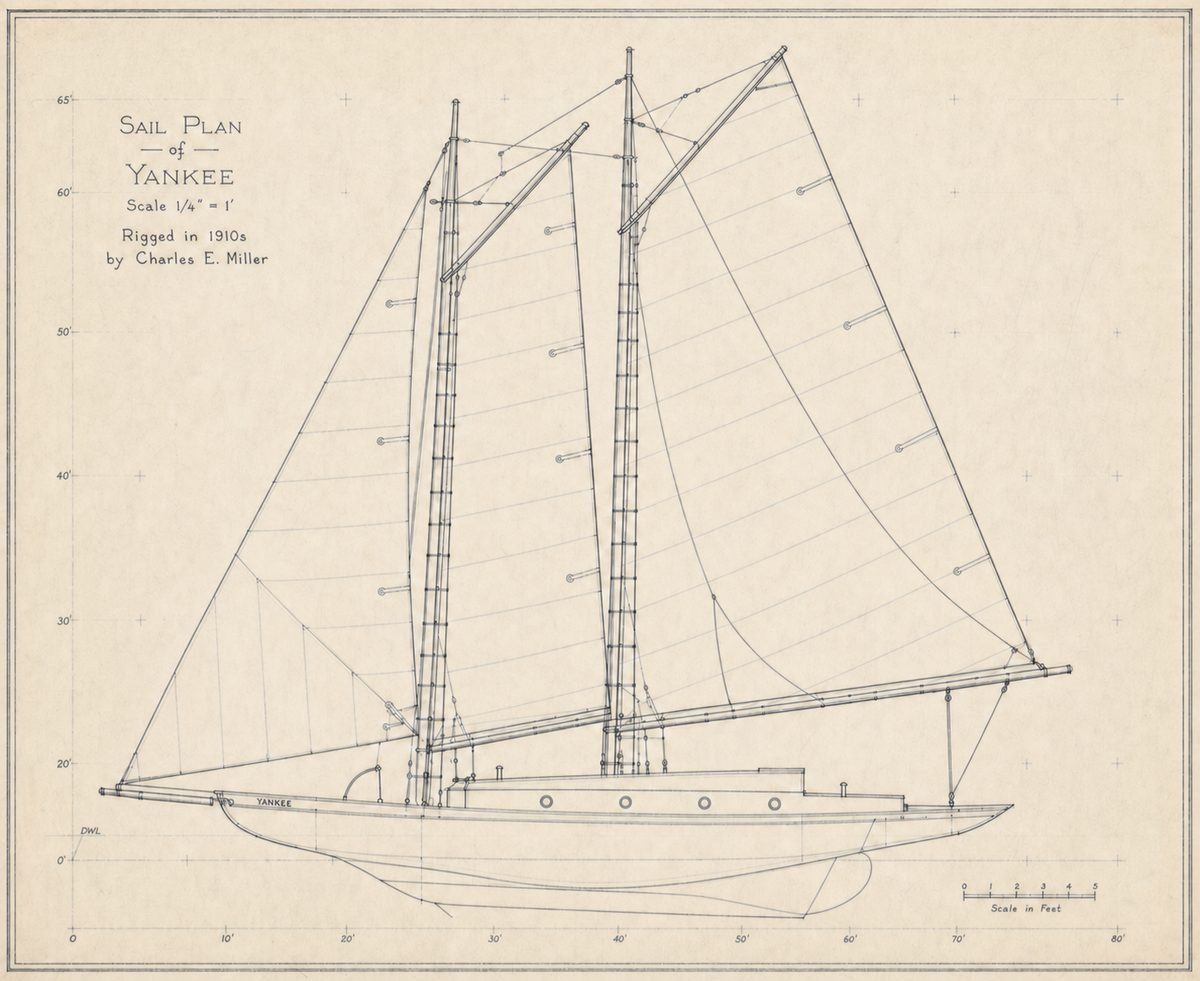
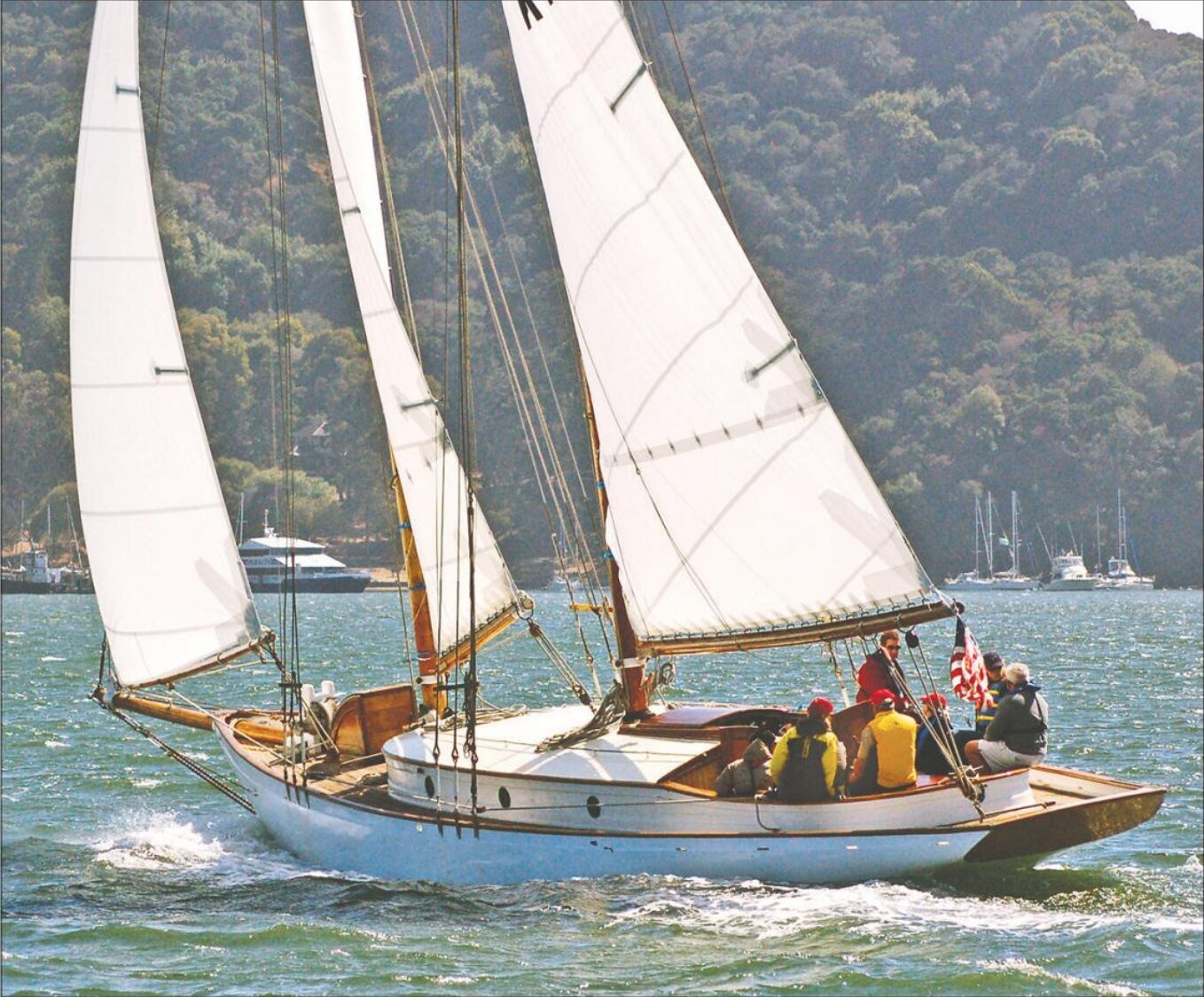
Yankee carries 1,475 square feet of working sail on a gaff rig and has never had a winch aboard. Every line is hauled by hand, so she is sailed by a large crew working together.
Yankee measures 52 feet 6 inches on deck and 36 feet on the waterline. With her bowsprit she is 62 feet 6 inches overall. Her beam is about 15 feet, though two family documents say 16, and she draws 5 feet 10 inches.
She sets three working sails: a jib of 395 square feet, a foresail of 335 and a mainsail of 745. That comes to 1,475 square feet. She was launched as a gaff sloop and has carried her schooner rig since the 1910s (Chapter 4). Chapter 1 describes the drawings of her that survive.
There are no winches. Every sheet and halyard is hauled by the crew. Her hands like to say that she is sailed with “wenches, not winches”.
Tacking and jibing.
In a tack or a jibe each person has a station and a job. One hand at the after end of the cockpit takes the mainsheet, and a second, inside the cockpit, works the cleat. The jib sheets run all the way aft to the sides of the cockpit, where hands at the rail tend them. Three more stand on the housetop forward. They handle the foresail and its gaff, and they help with the jib at the middle of its run.
Timing matters most. Once she is full and by in any breeze, her sails can hardly be trimmed further by hand. The helmsman has to time each maneuver to the pace of the crew’s work. John McNeill said that a helmsman calling her through a tack often sounds as if he is calling a barn dance.
Heeled hard in a blow she is a different boat. Her wide, heavy hull becomes long and slender in the water, and she drives with a power that has surprised her crews for more than a century. She will also surf, and one skipper warned that it will scare you to death.
Below decks.
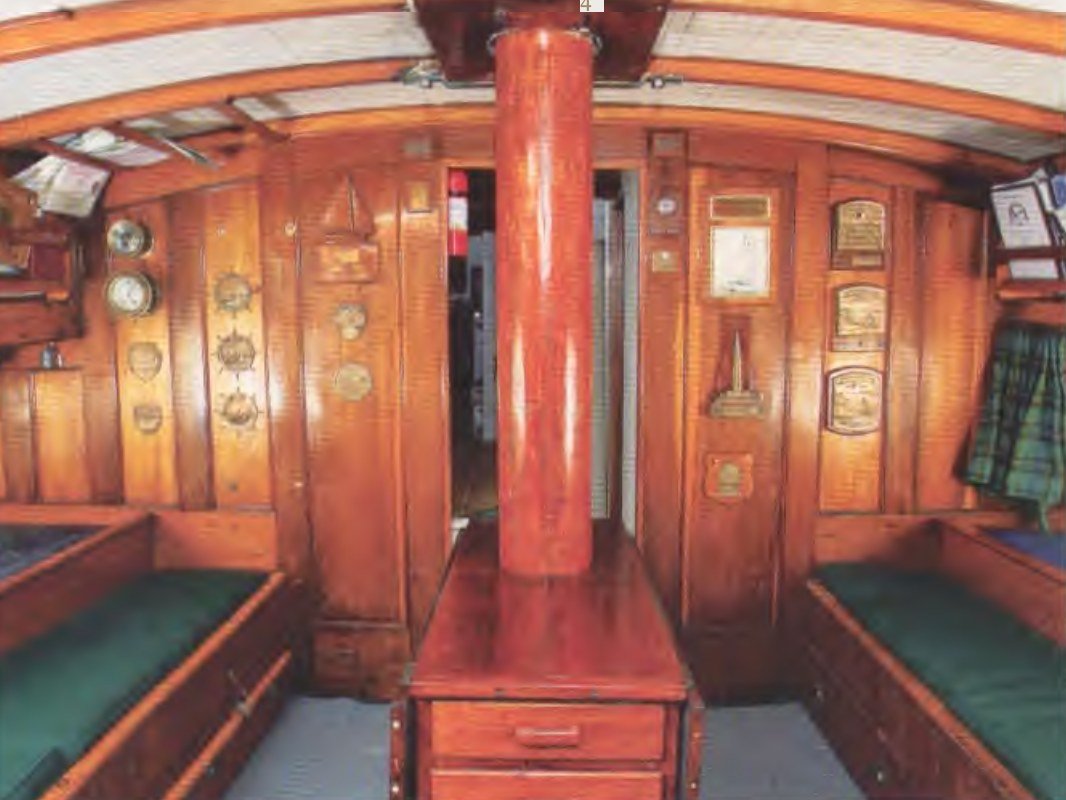
Down the companionway is the main saloon. It has settees along both sides, and the varnished mainmast comes down through the middle of it. The joinery is paneled and varnished. The bulkheads are hung with decades of trophy plaques and half-models, with the ship’s clock and barometer among them.
Much of her history happened in this room. Her log was signed here, by Walter Cronkite on the way to Tinsley Island in 1989 among many others (Chapter 15). The logbook’s raft-ups, Delta cruises and New Year’s mornings were spent here. A boat that people like to be aboard gets used, and a boat that is used gets looked after.
When Goldwyn’s company filmed Wild Oranges around her in 1923, its cabin scenes showed tufted settees under deck beams and a paneled companionway. They match her layout closely, though the even light suggests a set (Chapter 10).
Her engine.
She was launched without an engine, and Charles Miller added the first. The earlier history names her present engine as a Perkins 4-236 diesel, fitted in place of earlier gasoline engines. The yard’s working report lists a Perkins 4-108, taken from the survey. Nobody has yet checked the engine itself against either description, so we give both.